aircraft: Air India plane crash: No signs of bird hit or sabotage linked to the ill-fated AI-171 aircraft, says preliminary report

The Aircraft Accident Investigation Bureau (AAIB), in its first report released early Saturday, said, “No significant bird activity is observed in the vicinity of the flight path,” and made no reference to any act of sabotage.
Instead, the report points to a suspected fuel cutoff as a possible trigger for the crash, compounded by apparent confusion in the cockpit seconds before the London-bound flight went down.
According to the AAIB, both fuel switches feeding engines of Air India flight 171 were cut off moments after takeoff from Ahmedabad airport on June 12. The agency’s analysis of cockpit voice recordings suggests neither pilot acknowledged intentionally shutting off the fuel.
Also read: Report shows final emergency tech deployed seconds after takeoff; what it means & why it wasn’t enough
AI-171 crash: The last conversation between co-pilots
“In the cockpit voice recording, one of the pilots is heard asking the other why did he cutoff. The other pilot responded that he did not do so,” the report stated.
The aircraft had reached its maximum recorded airspeed of 180 knots at 08:08:42 UTC before both Engine 1 and Engine 2 fuel cutoff switches “transitioned from RUN to CUTOFF position one after another with a time gap of 01 sec.”
Following the cutoff, the engine parameters N1 and N2 — indicators of engine rotation speed — began to decrease from their take-off values, effectively leaving the aircraft powerless in mid-air.
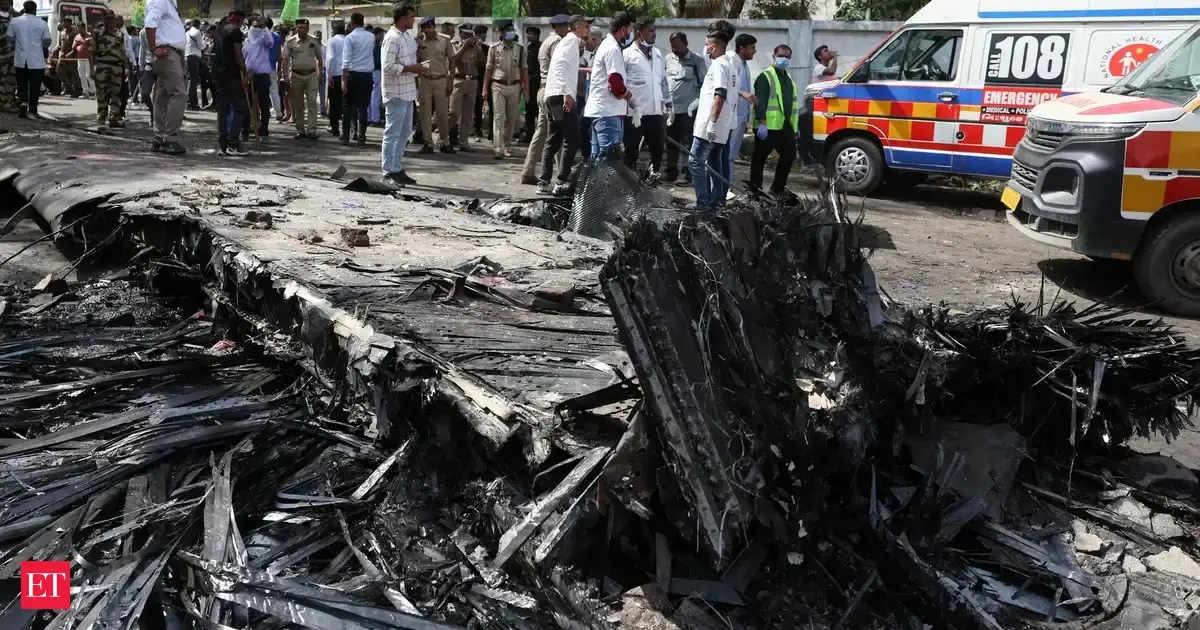
The plane crashed into residential quarters belonging to doctors of BJ Medical College in Ahmedabad’s Meghaninagar area and burst into flames. Of the 242 passengers and crew onboard, only one survived. The rest of the fatalities included both those on the aircraft and several victims on the ground, including nine students and their relatives living in the college premises.
Also read: A second-by-second account of what happened inside the cockpit before the deadly crash
As part of the investigation, the AAIB also tested fuel samples from bowsers and tanks used to refuel the aircraft. These samples, the report said, were “found satisfactory” after analysis at the Directorate General of Civil Aviation (DGCA) laboratory.
India’s worst aviation disaster in a decade
At exactly 13:08:39 IST on June 12, Air India flight AI-171, a Boeing 787 Dreamliner headed for London, began its takeoff roll from Ahmedabad with 54,200 kilograms of fuel onboard. The aircraft’s total weight was well within certified limits.
Moments after liftoff, however, events in the cockpit took a sudden and catastrophic turn. The aircraft’s fuel control switches—responsible for delivering fuel to the engines—were moved to the off position in quick succession, cutting off power to both engines. The cockpit voice recorder captured a brief, confused exchange between the pilots followed by a panicked distress call: “Mayday, mayday, mayday.”
But Air Traffic Control never got a chance to respond. Within seconds, the twin-engine jet lost altitude and slammed into the residential quarters of BJ Medical College, erupting into flames. The impact killed 261 people, including nearly all onboard and several on the ground.
In the aftermath, the Aircraft Accident Investigation Bureau (AAIB), under the Ministry of Civil Aviation, launched a full-scale probe.
Both engines were quarantined for detailed analysis. Fuel samples taken from the aircraft and ground-based refuelling equipment were later cleared, showing no irregularities.
Also read: The unanswered questions in govt’s 15-page preliminary findings into AI-171 tragedy
The AAIB is working closely with the aircraft and engine manufacturers to investigate every potential factor—from mechanical malfunction and system design to cockpit decisions and human error.
The crash marked the first complete airframe loss involving a Boeing 787 Dreamliner since its introduction, and the deadliest aviation accident in India in more than a decade.
A final report is expected after authorities complete an exhaustive analysis of the cockpit audio and flight data.