Vistara’s troubles could be a precursor to larger imminent problems in integration with Air India: Industry experts

The aviation-to-automobile conglomerate would do well to learn lessons from successful and problematic airline mergers across the world as well as how it overcame niggles after its own biggest purchases: Corus and Jaguar Land Rover, they added.
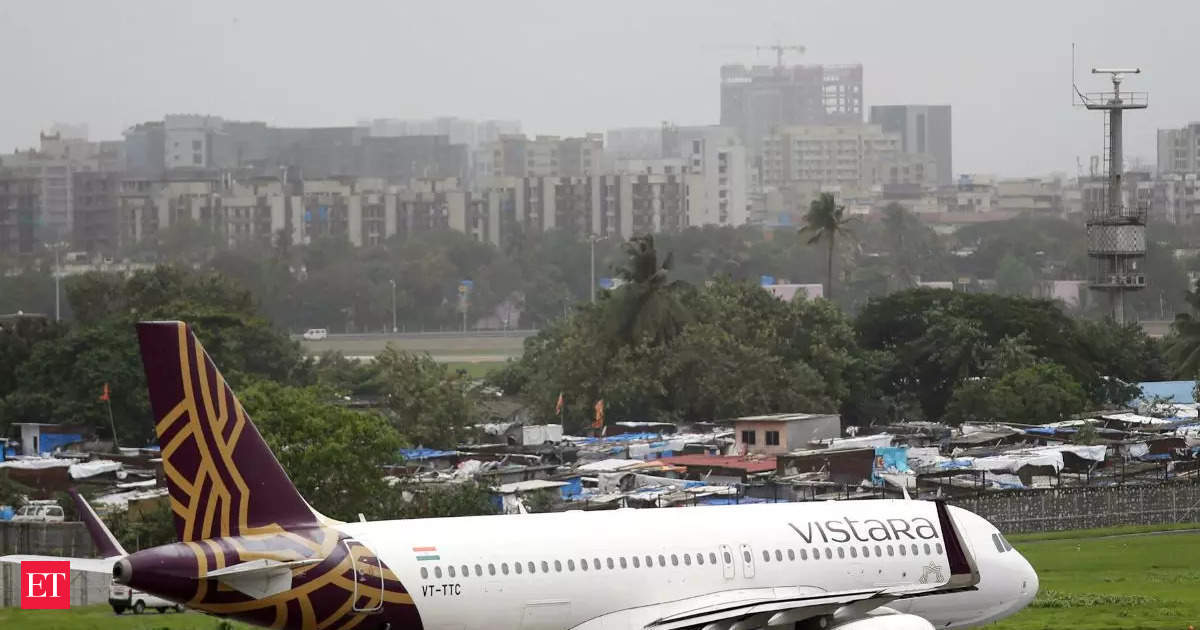
Vistara has temporarily slashed its daily 350-flight schedule by 10% after angry pilots repeatedly called in sick and stayed away from operations, forcing the airline to make ad hoc cancellations of close to 150 flights since April 1. The airline called the slashing, a “much-needed buffer” in pilot rosters.
While the current problem may be short lived, they are unlikely to be the last of issues in Vistara’s integration with Air India. The airline has been riddled with employee problems for the majority of its existence.
On Monday, technicians from its erstwhile unit Air India Engineering Services said they will strike work on April 23, over “grievances” over salary, promotion and service agreements. Formerly government owned, Air India was sold to the Tata group in January 2022 for Rs 18,000 crore. The engineering unit still provides services to the airline.
“We can never underestimate the cultural and human aspects of any merger between two companies,” said John Strickland, a London based independent aviation analyst; founder and director at JLS Consulting“It’s never just about spreadsheets, calculations and so called synergies, because human beings are not as neat and tidy as spreadsheets can be. And we’re talking about culture clashes, expectations, style of management and all of those things pose problems,” he added.One of the earliest of global airline mergers–British Overseas Airways Corporation (BOAC) and British European Airways (BEA) that formed British Airways in 1974–was problematic too.
“BOAC was the global long haul airline, and BEA was a European airline. It was a real clash of cultures actually reflecting British social strata. BOAC was seen as the airline of the public school boys, and BEA was seen as that of grammar school, state education employees. And there was absolute mistrust between the two breeds,” said Strickland.
One of the most contentious mergers in the world was between Air France and Dutch carrier KLM in 2004. The integration process was fraught for years with bitterness between the airlines, manifesting itself in regular industrial actions by employees, mostly of Air France.
“KLM was a very dynamic airline, if we think about the small scale of the Dutch market and KLM punching way above its weight in terms of its global network and passengers making connections.
It was fused with the relatively inefficient, regularly strike-prone Air France,” he added.
KLM, the smaller of the two, contributed several multiples of its partner to the group’s profits. Interestingly, the man steering KLM in its most trying and formidable years was Pieter Elbers, now the chief of India’s biggest airline IndiGo. Under new chief Ben Smith, the airline group brought in several changes including an overhaul of the top management and an ongoing fleet modernisation plan which helped it solve a large part of its problems.
Across the Atlantic, the Delta-Northwest merger was a roaring success and built the world’s most frequently profitable airline entity. But a merger between American Airlines and US Airways was fraught with difficulties on staff integration especially in terms of pilots.
“The pilot workforce is a particularly sensitive and complicated one to integrate in, in any situation of a merger because pilots have some of the strongest voices when it comes to bargaining power and union representation in airlines. That means their union representatives will negotiate the best possible deals not only in terms of pay, but in terms of seniority of pilots getting benefits for length of service,” said Strickland. Vistara pilots’ ire stems from pay and seniority both of which would be limited in their progression under the new contract, they have alleged.
Vistara is a smaller airline getting merged with a larger entity. A case parallel to that is Ryanair’s acquisition of a UK-based low cost airline, an erstwhile KLM group entity, called Buzz. Ryanair moved quickly to eliminate the entire workforce of the airline, terminate the brand and fuse it with itself.
In comparison, the delay in consummating the Vistara-Air India merger due to pending regulatory approvals has created significant uncertainty among its employees, said industry experts.
Ryanair’s rival Easyjet’s acquisition of a British LCC Go also took considerable time to integrate.
But the Tata group can derive lessons of difficult integration processes from its own history: its $12.1 billion purchase of Corus and the $2.3 billion buyout of JLR.
Both involved the meshing of work cultures, processes and financial statements of companies that were far more divergent than Air India and Vistara.
“Being British companies, had huge debt obligations and legacy costs linked to employees and pension funds,” said Mahantesh Sabarad, an independent market analyst, former head of retail research at SBI Securities and an 8 year veteran at Tata Motors.
“Corus for example, had a large pension fund liability and funding arrangement.. Likewise, JLR had its own pension schemes that needed to be funded periodically,” said Sabarad, adding that like Air India, Corus and JLR too had problems with inflated workforces.
Sabarad added that an over-dependence on expat management had been Tata’s undoing then, adding that the group should depend on an Indian top management to steer Air India.